
Fraud detection solution: why insurers can no longer rely on AI alone
How reliable can a fraud detection solution still be in the age of AI-generated documents ?
This is the question now facing insurers, brokers, and retail players confronted with a surge in fraud that has become faster, cheaper, and easier thanks to artificial intelligence.
The answer is uncomfortable, yet increasingly clear : detection alone is no longer enough.
The fight against insurance fraud must fundamentally change its logic.
Insurance fraud is becoming industrial — and AI is accelerating it
Fraud is no longer marginal. It is becoming standardized, automated, and increasingly industrialized.
Let’s take the case of the Netherlands for exemple. The warning signs are already tangible :
- More than 9,000 insurance fraud cases recorded in 2024, an increase of 1,000 cases compared to 2023.
- In December alone, online retailers with automated return systems (including Amazon, Zalando, and ASOS) reported receiving at least 1,000 AI-manipulated claims in a single month.
In practical terms: a customer buys a pair of trousers online (around €50), uses an AI tool to generate a photo showing the item as “severely damaged,” submits a claim… and receives a refund or replacement, even though the product is perfectly intact.
Fraud is becoming almost free for fraudsters.
And above all, it has become remarkably easy to execute.
Why fraud detection solutions are reaching their limits
Faced with this threat, the reaction is logical : strengthen the insurance fraud detection system.
Image analysis, anomaly detection, fraud scoring, data cross-checks — insurers are investing heavily in AI to “separate the real from the fake.”
But there is a structural problem:
- The AI tools used for fraud are accessible, easy to use, and low-cost (often free), and they evolve continuously.
- Fraud detection AI systems are becoming increasingly complex, increasingly expensive, and can never guarantee zero doubt.
One expert cited in the article highlights a typical example: an AI-generated crack on a windshield can be almost indistinguishable from a real one. Yet, depending on the insurer, compensation may be granted solely on the basis of a photo.
The result is straightforward: when fraud is not detected, claim payouts increase — and so do premiums.
And even with advanced detection, one reality remains : there will always be doubt after the fact.
The Netherlands is a preview of what lies ahead for France
What is happening in the Netherlands is not an anomaly.
It is a preview of what awaits the wider European ecosystem — including France.
For insurers, the stakes are significant:
- rising levels of undue compensation,
- growing operational costs (controls, investigations, tools),
- legal and reputational risks,
- and a critical issue: unjustified suspicion that penalizes honest customers.
Insurance fraud prevention is therefore becoming a strategic priority — but it cannot rely solely on an endless technological arms race.
The core issue: making decisions based on “documents”
Most current approaches follow the same pattern:
- An insured party submits documents (photos, invoices, supporting evidence).
- The insurer attempts to verify them afterwards using a fraud detection solution.
- A decision is made… with a degree of uncertainty.
The problem is that documents have become highly manipulable:
a photo, invoice, or receipt no longer proves much when taken in isolation.
The real question is therefore: how can uncertainty be reduced before detection even begins?
Shifting the paradigm: from detection to prevention at the source
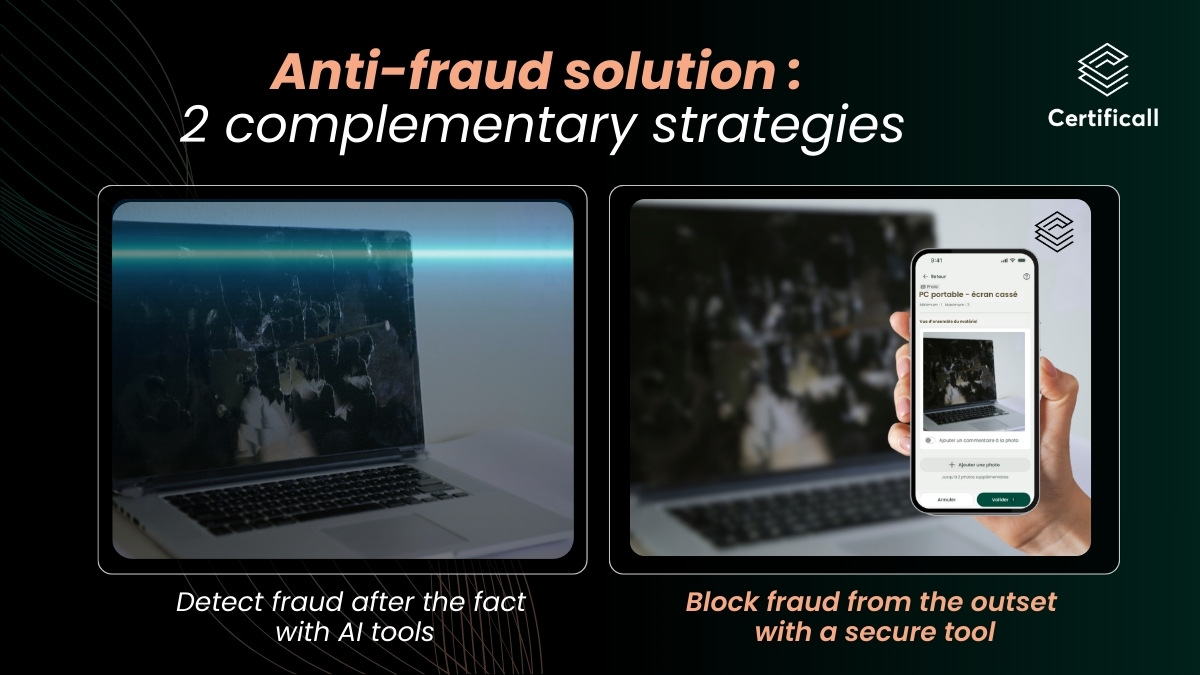
There is another path: blocking fraud at the very beginning, at the moment the evidence is created.
In other words, stop analyzing afterwards and secure trust upfront.
This is precisely the role of digital trust service providers: actors that make it possible to capture evidence with strong guarantees of authenticity and integrity.
Certificall: certifying field evidence to reduce uncertainty
Certificall certifies digital data and transforms it into tamper-proof evidence : photos, videos, GPS position (depending on use cases), combined with geolocation and timestamping, through a mobile application. The resulting evidence is legally admissible under French and European law.
The principle is simple: instead of allowing evidence to be freely produced and later disputed, it is framed and sealed at the moment of capture.
Certificall integrates directly into business processes across insurance, construction, transport, real estate, and public authorities, covering typical use cases such as:
- property condition reports,
- construction site monitoring (before / during / after),
- proof of proper execution of a service,
- claim declarations and damage reporting.
In practice, certification relies on:
- enhanced geolocation,
- eIDAS certified timestamping (ISO 8601),
- eIDAS-compliant electronic sealing via a trust service provider,
- secure storage (up to 10 years depending on requirements),
- tamper-proof certificates (PDF/A format, cryptographic hash) with full traceability.
Crucially, a business-specific capture workflow can guide field users step by step to collect relevant, consistent, and complete evidence — embedded directly into day-to-day operations.
What this changes for fraud detection solutions
An anti-fraud detection solution, particularly for insurance, remains useful — but its role is evolving:
- It should no longer be the final safeguard trying to guess what is real.
- It should rely on evidence whose authenticity has already been strengthened.
In other words: less money spent chasing fake claims, and more value created by securing genuine ones.
Conclusion : decisions can no longer rely on documents alone
In a world where everything can be falsified, decision-making can no longer be based on simple documents.
It must be embedded within operational processes built on certified evidence, guaranteed by trusted third parties — from the moment of capture, from the moment of declaration, from the very start.
Because in the age of AI, the challenge is no longer just detecting fraud.
It is about reducing doubt.
