
Skip to content
  • Our solution
  • Use cases
    • Insurance
    • Construction
    • Transport & logistics
    • Real Estate
    • CEE
  • Resources
    • About us
    • FAQ
    • Support
    • Check your certificate
  • 📞 +33 1 89 71 82 14
  • Login
  • English
Get in touch
Digital evidence

Photo of a Photo: How Certificall’s Sovereign AI Detects Fraud at 87%
29 May 2026 Simon Febvre No comments yet
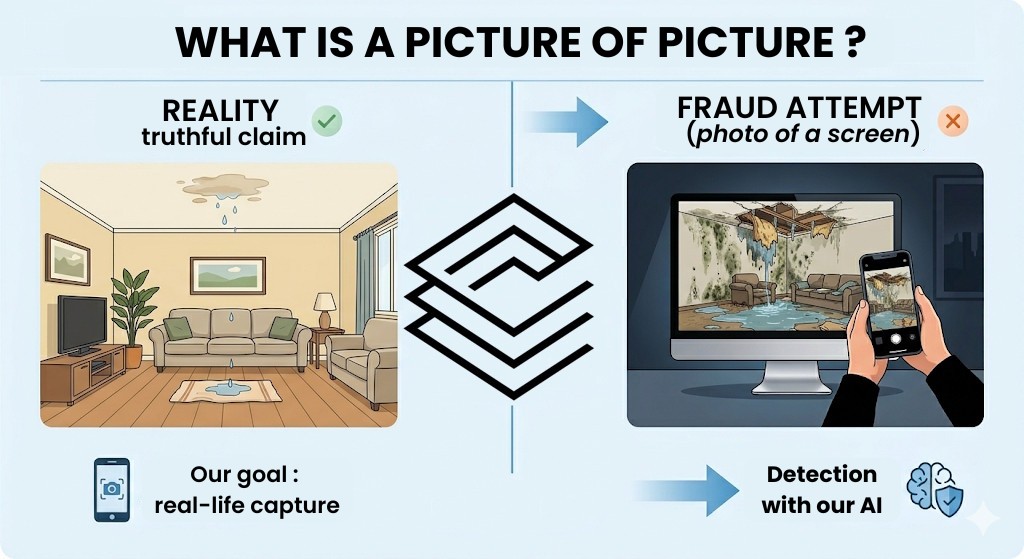
What is photo of a photo and how it is detected with Certificall AI as an image fraud

A certified photo compliant with the eIDAS regulation carries recognized evidentiary weight under French and European law. Qualified timestamping, electronic seal, enhanced geolocation, SHA fingerprint, secure PDF/A-3B storage : the certification chain is robust by design.

But a certification chain cannot guarantee that what is submitted to it at the point of capture is authentic. This is true of every photo collection tool — mobile application, web portal, field solution. And that is precisely where some attempt to intervene.

The question Certificall has chosen to tackle head-on : how can you guarantee that the image submitted for certification truly reflects reality, and not an attempt at manipulation?

Manipulation attempts at the collection stage : a universal challenge

Every tool that collects photos as evidence is exposed to circumvention attempts. Certification secures the document after it has been created. It does not replace an analysis of the image itself.

Among the possible manipulations at the collection stage, the photo of a photo is one of the simplest to carry out. It consists of photographing an existing image — displayed on a screen or printed on paper — and submitting it as though it were a genuine capture taken in the field. No specialist tool required. A smartphone is enough. The attempt is discreet. And without a dedicated detection system, it is difficult to identify.

For businesses using certified photo solutions, the potential consequences are concrete:

Business contextManipulation risk
Insurance claimPhotos that do not correspond to the actual damage
Site inspection or property inventoryA previous or fabricated situation presented as current
Proof of service deliveryAttestation of work that was never carried out

Most collection tools on the market have no mechanism to detect this type of manipulation. Certificall made the opposite choice — from day one.

Why general-purpose AI is not enough for this specific problem

When faced with this threat, the natural instinct is to rely on the most powerful AI models available. But on this precise task, raw power is not enough. And it raises a data sovereignty problem.

A general-purpose AI is trained to handle a very broad range of situations. It performs well across many contexts. But without training data drawn from the real-world context of field photo collection — device diversity, variable capture conditions, image types specific to professional use cases — its accuracy on photo-of-a-photo detection remains insufficient for professional deployment.

 General-purpose AISpecialist AI (Certificall)
ScopeBroad range of tasksOne task, one context
Training dataGeneric, multi-domainDrawn from Certificall’s real operational context
SovereigntyDependent on a third-party providerProprietary, hosted in-house
Accuracy (May 2026 benchmark)~50% on average87%

This is the fundamental principle of an effective image and photo fraud detection AI : it must have learned to recognise the signals specific to the context in which it operates.

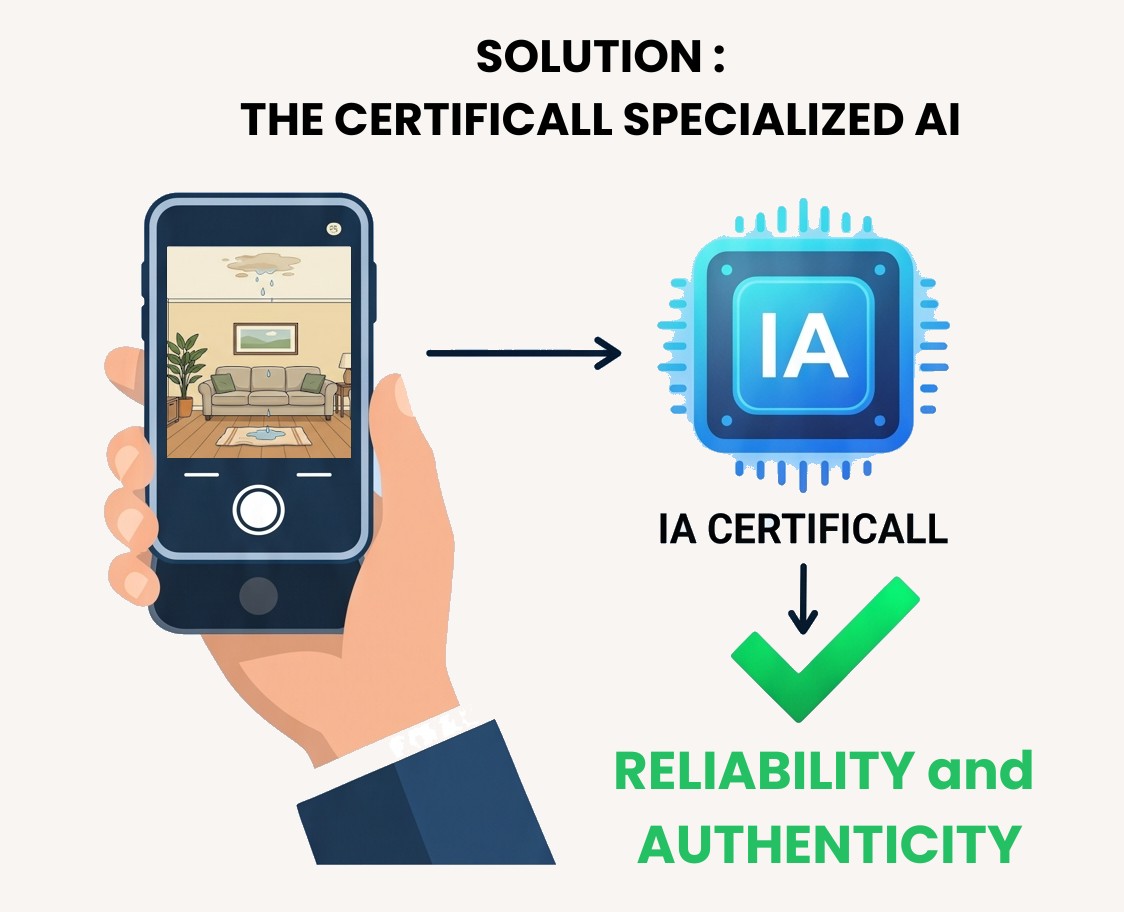
the specialized AI to detecte photo of a photo fraud with Certificall

Contextual specialisation outperforms raw power.

Certificall built its AI on this principle. Not by adapting an existing model. By developing a proprietary, sovereign model, trained exclusively on this use case under the real operating conditions of the solution.

Certificall’s proprietary AI: sovereign, specialist, benchmarked

A model built from within

Certificall’s photo-of-a-photo detection AI is proprietary. It is not hosted by a third party, nor dependent on an external API. It is sovereign — developed, trained, and fully controlled in-house, using data drawn from the real operational context of the Certificall solution.

This is a structural choice. It guarantees Certificall’s technological independence, the confidentiality of processed data in compliance with the GDPR, and the ability to continuously improve the model without depending on an external provider.

The May 2026 benchmark

In May 2026, Certificall conducted a rigorous benchmark to objectively measure the performance of its AI against leading models on the market.

Benchmark parameterValue
Images analysed500
AI models tested11 (including 10 general-purpose models)
ProtocolIdentical prompt used for all AI models tested
Statistical measuresMcNemar test + F1 score
Certificall overall accuracy87%
Ranking positionEquivalent to the global leader
General-purpose AI models outperformed8 out of 10

The McNemar test is a statistical tool that validates whether a performance difference between two models is genuine and not due to chance. A higher score alone is not enough: the difference must be statistically significant to be conclusive. Certificall’s results are presented on this basis.

A model trained on a single task, in its true business context, matches the most accurate general-purpose AI tested — and outperforms 8 out of 10 general-purpose models.

The Trust Score: from detection to decision

More than 30 criteria analysed automatically

The photo-of-a-photo detection AI feeds into the Certificall Trust Score — a confidence indicator calculated automatically for every dossier submitted to the solution, based on more than 30 criteria analysed simultaneously, grouped into 7 scores.

The Trust Score is an analysis layer that operates at the entry point of the process, before certification. It does not replace the client’s judgement: it provides a documented, timestamped, traceable indicator so they can validate with full information — not blindly.

Concrete value for B2B decision-makers

BenefitWhat it changes in practice
Fewer undetected manipulation attemptsPhoto-of-a-photo attempts are intercepted before the dossier is validated
Better-documented decisionsA searchable, traceable analysis history for every dossier
Formalised accountabilityA shared indicator between Certificall and its client organisations

An eIDAS-compliant certified digital proof only carries its full legal weight if what it represents is authentic. The Trust Score is the mechanism that makes this authenticity verifiable at the point of entry.

A pioneer’s commitment, not a finished product

To our knowledge, Certificall is one of the first B2B certified photo solutions to have developed a proprietary, sovereign AI dedicated to photo-of-a-photo detection — validated by a rigorous statistical benchmark against leading models on the market.

87% accuracy is not 100%. Claiming otherwise would be a commercial posture, not a technical commitment. Transparency on this point is the hallmark of serious R&D work.

The objective is clear: enrich the training data, refine the model, continuously improve the detection rate — in step with the real-world usage of the solution. This is only one step.

eIDAS-compliant digital proof deserves protection commensurate with its legal value. This is a long-term commitment.

→ Contact Certificall to discover the Trust Score and see how our fraud detection AI integrates into your photo collection workflows.

Frequently asked questions

❓ Is photo-of-a-photo fraud specific to certified photo solutions?
No. Photo-of-a-photo is a manipulation attempt that affects every photo collection tool, whether or not it certifies the images produced. Certification secures the document after it has been created — it does not replace an analysis of the authenticity of the image submitted at the point of entry.

❓ Why did Certificall build its own AI rather than using an existing model?
General-purpose models, however powerful, do not have training data drawn from the real-world context of field photo collection. Certificall’s proprietary AI is trained exclusively on this use case, under the real operating conditions of the solution — which gives it superior accuracy on this precise task.

❓ What is the Certificall Trust Score?
The Trust Score is a confidence indicator calculated automatically for every dossier submitted to Certificall. It is based on more than 30 criteria analysed simultaneously, grouped into 7 scores — including photo-of-a-photo detection. It allows users to validate a piece of evidence with full information, rather than blindly.

❓ What does sovereign AI mean?
A sovereign AI is a model developed, trained, and fully controlled in-house, with no dependency on an external provider or API. Certificall’s AI is proprietary: the data it processes remains within the solution’s secure environment, in compliance with the GDPR.


Get in touch with us to explore our AI anti-fraud solution

GO !

Simon Febvre

Post navigation

Previous

Search

Categories

  • Claim fraud (1)
  • Digital evidence (1)
  • Insurance (1)

Recent posts

  • Photo of a Photo: How Certificall’s Sovereign AI Detects Fraud at 87%
  • Fraud detection solution: why insurers can no longer rely on AI alone

Tags

fraud detection solution fraud prevention

Related posts

Claim fraud, Insurance

Fraud detection solution: why insurers can no longer rely on AI alone

8 January 2026 Simon Febvre No comments yet

How reliable can a fraud detection solution still be in the age of AI-generated documents ?This is the question now facing insurers, brokers, and retail players confronted with a surge in fraud that has become faster, cheaper, and easier thanks to artificial intelligence. The answer is uncomfortable, yet increasingly clear : detection alone is no […]

Download the app

A simple and intuitive mobile app to certify your photos / videos and ensure trust between parties

Product
  • Use cases
  • Our solution
  • Login
Use cases
  • Insurance
  • Construction
  • Transport
  • Real estate
  • ESC
Resources
  • FAQ
  • Documentation (FR)
  • Assistance
  • Check your certificate
Company
  • Contact us
Legal pages
  • Privacy policy
  • Legal notices
  • Cookies
Follow us