
Claims verification at First Notice of Loss : how to secure your claims from day one
Claims Verification at First Notice of Loss: How to Secure Your Claims From Day One
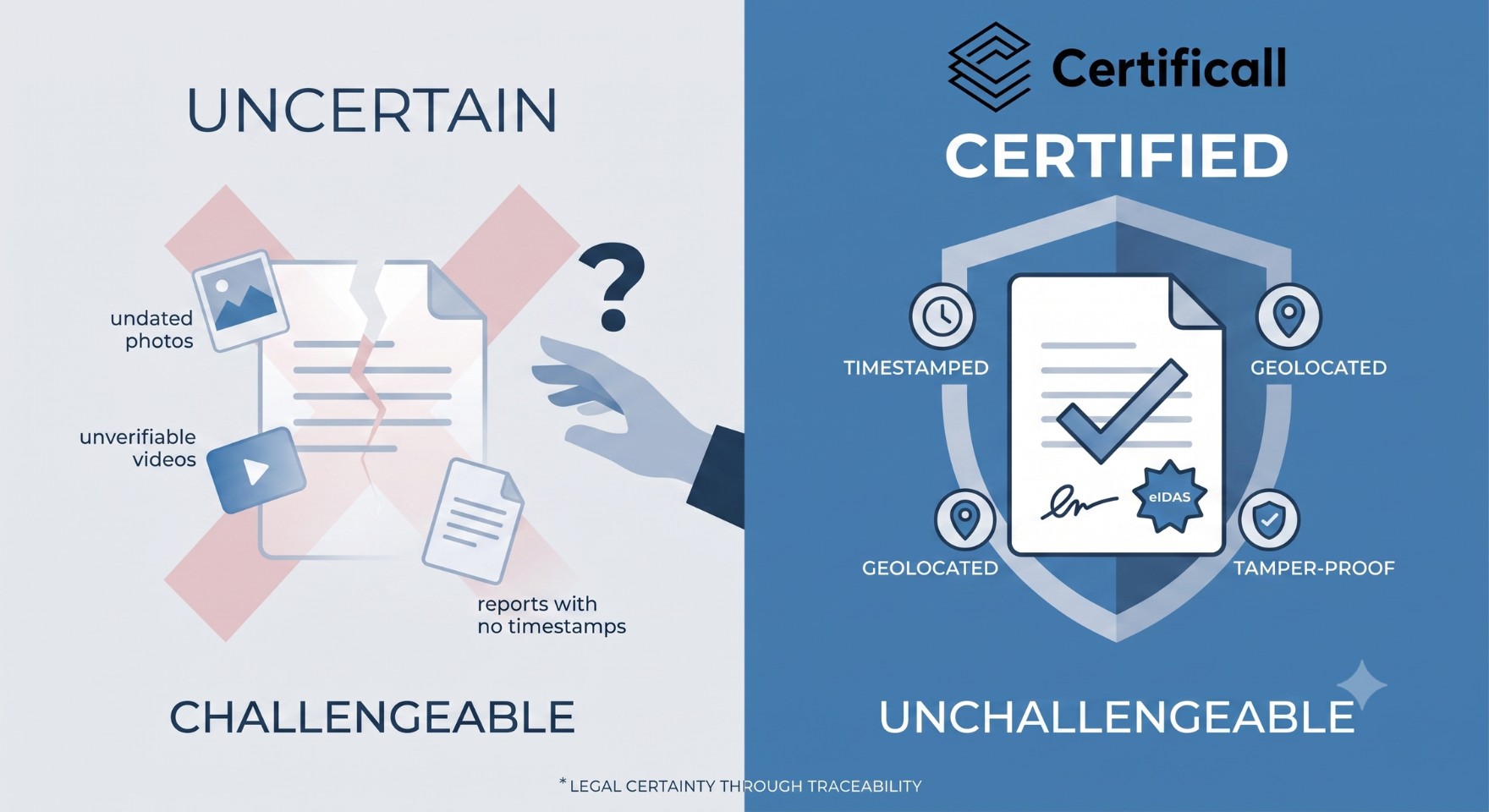
How can insurers and brokers verify a claim at first notice of loss without slowing down the policyholder’s journey or sending someone out to site every time? Certificall offers a concrete answer: every photo or video taken on a smartphone becomes a time-stamped, geolocated, digitally certified piece of evidence, submitted directly by the policyholder through the CertiLink feature. Claims verification at first notice of loss refers to the checks carried out as soon as a claim is opened, to confirm that the policyholder’s account, the circumstances and the observed damage are consistent with one another. This is the moment when most decisions are made: requesting supporting documents, settling the claim directly, or escalating it to a loss adjuster.P&C insurance fraud: an issue decided at first notice of loss
Documentary fraud on claims is notoriously hard to prove, because the insurer must establish both the inaccuracy of the facts and the intent to deceive. Without reliable evidence gathered at the right moment, that burden of proof becomes a real obstacle to any action. Certificall positions itself as a first line of verification and control, not as a tool that would make fraud impossible. A certified claim photo from Certificall combines ISO 8601 time-stamping, geolocation and a cryptographic hash, which helps resolve doubt over when and where the damage occurred, without claiming to replace human expert judgement on complex files.Faster claims handling without compromising the policyholder experience
The duty of care owed by insurance distributors does not end at the point of sale: it extends throughout the life of the policy, including at the moment of loss. For both broker and insurer, every day lost during claims verification has a direct impact on customer satisfaction, now a strategic metric in a market where the digital experience drives retention. With CertiLink, the policyholder receives a secure link and documents the situation themselves as soon as the loss occurs, with no account to set up and no adjuster to send out. For low-value claims, this step often replaces the wait for an independent loss adjuster’s report, where the reference turnaround time is typically up to 21 days. For claims where the scene changes quickly — water damage, or seepage following a hailstorm — CertiLink captures the evidence before the damage evolves or disappears.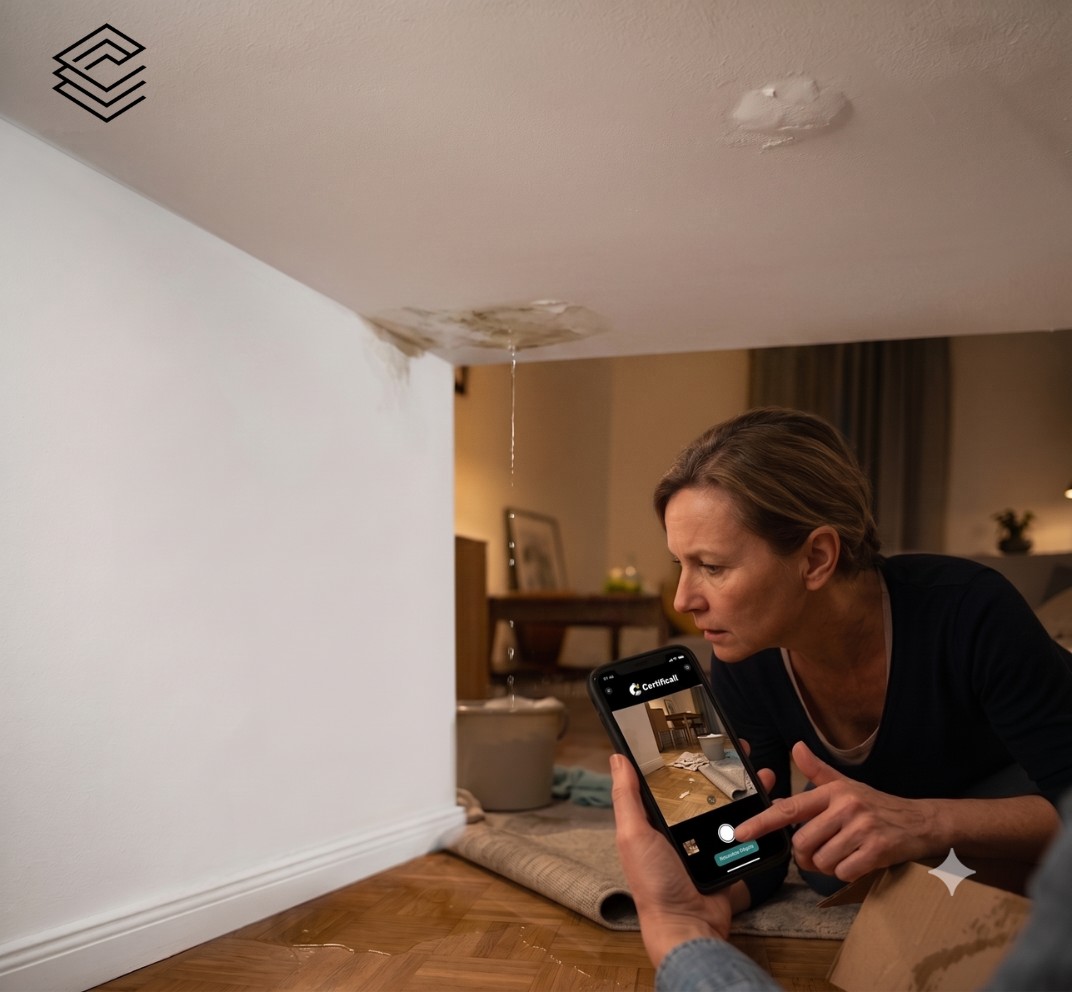
Concrete example : the water damage
A policyholder reports water damage in their flat on a Sunday evening. Their insurer sends a CertiLink text message. Within minutes, the policyholder documents the scene by following a simple, guided sequence built into the app :
- An overview shot of the affected room, to establish the scale of the loss.
- A photo of the visible source of the leak (seal, pipework, ceiling), where identifiable.
- Close-up shots of each damaged area (walls, floor, ceiling, contents).
- Photos of each damaged item of contents, taken individually if several are affected.
- A dated contextual item, such as a water meter reading or a receipt for a recent purchase, where available.
What to collect for a reliable claim file
| Information to collect | Stake for the broker | Stake for the insurer | Certificall advantage |
|---|---|---|---|
| Circumstances, date and location of the loss | Avoid the back-and-forth that slows down claims handling and damages the client relationship | Check the consistency of the account before commissioning a loss adjuster | CertiLink time-stamps and geolocates the claim as soon as it’s submitted by the policyholder |
| Photos of the damage | Document the file without visiting the client on site | Obtain admissible evidence to justify a fast decision | Certified photos captured remotely by the policyholder via a secure link |
| Quote followed by the final invoice for repairs | Point the client to the right supporting documents from the outset | Check that the quote, invoice and reported damage match up | Before/after photos attached to the same certified file |
| Identity and contact details of a liable third party | Secure a file with subrogation potential | Increase the subrogation recovery rate on low-value claims | Geolocated proof of the origin of the loss, usable to support subrogation |
| Prior history or recurrence of similar claims | Protect their credibility if the file is disputed | Detect recurring fraud patterns | History of certified photos searchable file by file |
Claims verification across common loss types
| Type of claim | Red flag to watch for | Key document to request | Certificall / CertiLink advantage |
|---|---|---|---|
| Motor material damage | High repair costs for a loss reported as minor | Dated photos, garage quote, invoice | Certified photos submitted via CertiLink right after the incident, no adjuster visit needed |
| Motor glass damage | Unusually frequent claims from the same policyholder | Invoice or work order | Time-stamped history available to flag repeat patterns |
| Vehicle theft / attempted theft | No consistent signs of forced entry | Police report, photos of the vehicle | Geolocation of the claim submission, useful for cross-checking the location of the theft |
| Home water damage | Source of the damage cannot be identified | Photos before repairs, plumber’s quote then invoice | CertiLink captures the scene before the water drains away or repair work begins |
| Home fire damage | Account inconsistent with the scale of the damage | Photos, contents inventory, invoices for damaged items | Certified photo evidence of the scene as soon as the fire service attends |
| Home theft / burglary | Items claimed without proof of purchase | Police report, invoices, photographed inventory | Geolocated photos of forced entry points, usable for the claims investigation |
| Malicious damage / vandalism | Isolated damage with no witness | Quote, invoice after repair | CertiLink documents the initial condition before any repair takes place |
| Storm / hail / weather event | Damage reported outside the affected area or time window | Photos, quote, invoice | Geolocated, time-stamped evidence that can be checked against the official weather event |
| Repairs settled on invoice | Invoice does not match the original quote | Quote, itemised invoice, before/after photos | Before/after photos attached to the same certified file, limiting over-billing |
Taking it further
Certificall helps insurers and brokers build more reliable claim files through certified photo and video evidence. Find out how the CertiLink feature fits into your claims handling journey.Get in touch with us to explore our solution
FAQ
What is claims verification at first notice of loss?
It is the set of checks carried out as soon as a claim file is opened, to confirm that the policyholder’s account, the circumstances and the observed damage are consistent with one another.
Can Certificall guarantee that a claim is not fraudulent ?
No. Certificall is a decision-support tool that limits opportunities for fraud and provides a first line of verification; it does not replace expert appraisal on complex files.
How does CertiLink work for a policyholder?
The policyholder receives a secure link, with no account to set up, and takes the requested photos or videos themselves, which are uploaded as certified evidence to the claims file.
Does CertiLink always remove the need for a loss adjuster?
No. CertiLink is best suited to low-value claims or situations that need to be captured quickly; complex files are still routed to a conventional expert appraisal.
Does a photo taken via CertiLink carry different evidential weight than an ordinary photo?
Yes. It includes ISO 8601 time-stamping, geolocation and a cryptographic hash, which sets it apart from an ordinary photo whose evidential value is more easily challenged.
