
How to contest your taxe foncière: the evidence that counts with Orka.tax and Certificall

How do you contest your taxe foncière when you suspect an error? The process has two stages: find the error in the official description of your property, then prove it. ORKA.TAX and Certificall now cover both stages, from spotting the anomaly to building a solid claim file.
Key points in 30 seconds
- According to figures published by ORKA.TAX, 87% of the property tax notices it checked were overvalued, with an average confirmed gap of €260 a year.
- An overvalued taxe foncière almost always comes from an inaccurate description of the property: floor area, amenities, category, state of repair or outbuildings.
- The tax rates voted by local authorities cannot be challenged, but the tax base can be checked and corrected.
- Certificall gives owners certified photos and videos whose date, location and integrity will be hard for the authorities to dispute.
Contesting your taxe foncière: a legitimate step that few owners take
The cadastral rental value (valeur locative cadastrale) is the theoretical annual rent the French tax authorities assign to a property. It is the base used to calculate the taxe foncière, France’s annual property tax.
This value relies on a description of the property recorded by the tax authorities: number of rooms, floor areas, amenities, state of repair. The rates per square metre were set using 1970 rent levels. The description itself is rarely updated after renovation work.
As a result, a bathtub replaced by a shower, a sealed rubbish chute or a removed gas meter can stay on record for years. Owners never automatically receive the form that describes their property. They pay a tax calculated on a home that no longer exists as described.
According to ORKA.TAX, fewer than 2% of owners contest their taxe foncière each year. Yet the figures from the files it has analysed show that errors are the rule rather than the exception.
87%
of checked notices overvalued
Share of the notices analysed by ORKA.TAX that showed an overvaluation.
€260
average gap per year
Average confirmed difference between the tax paid and the tax due.
2,127
full analyses
With €933,646 of overvaluation detected in total.
Source: internal ORKA.TAX data published on orka.tax (page updated on 14 September 2026, in French).
How the taxe foncière is calculated, in 8 steps
To know where to look for an error, you need to follow the calculation. The first four steps build the cadastral rental value, the next ones turn it into a tax. Each step is based on the French General Tax Code (Code général des impôts, CGI).
- Actual floor area of each room, weighted by its type (article 324 M, annex III to the CGI).
- Equivalent floor areas: notional square metres added for each amenity (article 324 T, annex III).
- Adjustments recorded on the assessment form, including the state-of-repair coefficient (article 324 Q, annex III).
- Multiplication by the rate per square metre of the property’s cadastral category.
- Annual indexation of rental values: +0.8% in 2026 (article 1518 bis of the CGI).
- 50% allowance on the rental value of built property (article 1388 of the CGI).
- Application of the tax rates voted by the municipality and the intermunicipal authority.
- Amount of taxe foncière shown on the tax notice.
Steps 1 to 4 describe the property: they are where errors concentrate, and they are what a claim can correct.
Overvalued taxe foncière: the five items where errors hide
ORKA.TAX compares each item on the assessment form with the actual property. Five items come up again and again in the gaps it finds.
| Item | What the tax authorities record | What you need to prove |
|---|---|---|
| Weighted floor area | Area of each room, weighted according to whether it is a main or secondary room | Actual measurements and the exact number of rooms |
| Amenities | Notional square metres added: 5 for a bathtub, 4 for a shower, 3 for a washbasin or toilet, 2 per heated room | That the amenity is missing or was removed (bathtub, bidet, rubbish chute, gas supply) |
| Cadastral category | One of eight categories, which sets the rate per square metre | The actual quality of the building and its surroundings |
| State of repair | A coefficient that can reach 1.20 | The actual condition of walls, floors, joinery and common areas |
| Outbuildings | Garage, cellar or garden shed, valued separately and then added | Whether each outbuilding exists, its area and its actual use |
The state-of-repair coefficient, an often overlooked lever
The state-of-repair coefficient is the adjustment that raises or lowers the rental value according to the building’s condition. Article 324 Q of annex III to the CGI sets the scale. A “fair” (passable) condition corresponds to 1, a “fairly good” (assez bon) condition to 1.10.
France’s highest administrative court, the Conseil d’État, applied this scale in a decision of 22 December 2025 (no. 474931, in French). It ruled that a house whose permanent defects were due to age fell into the “fair” category, not “fairly good”. The taxes for several years were recalculated on that basis.
The state of repair is not proven by assertion: it is proven with dated, geolocated images of the property.
Spotting an error is not enough
For the tax authorities, an error only exists if the owner can prove it.
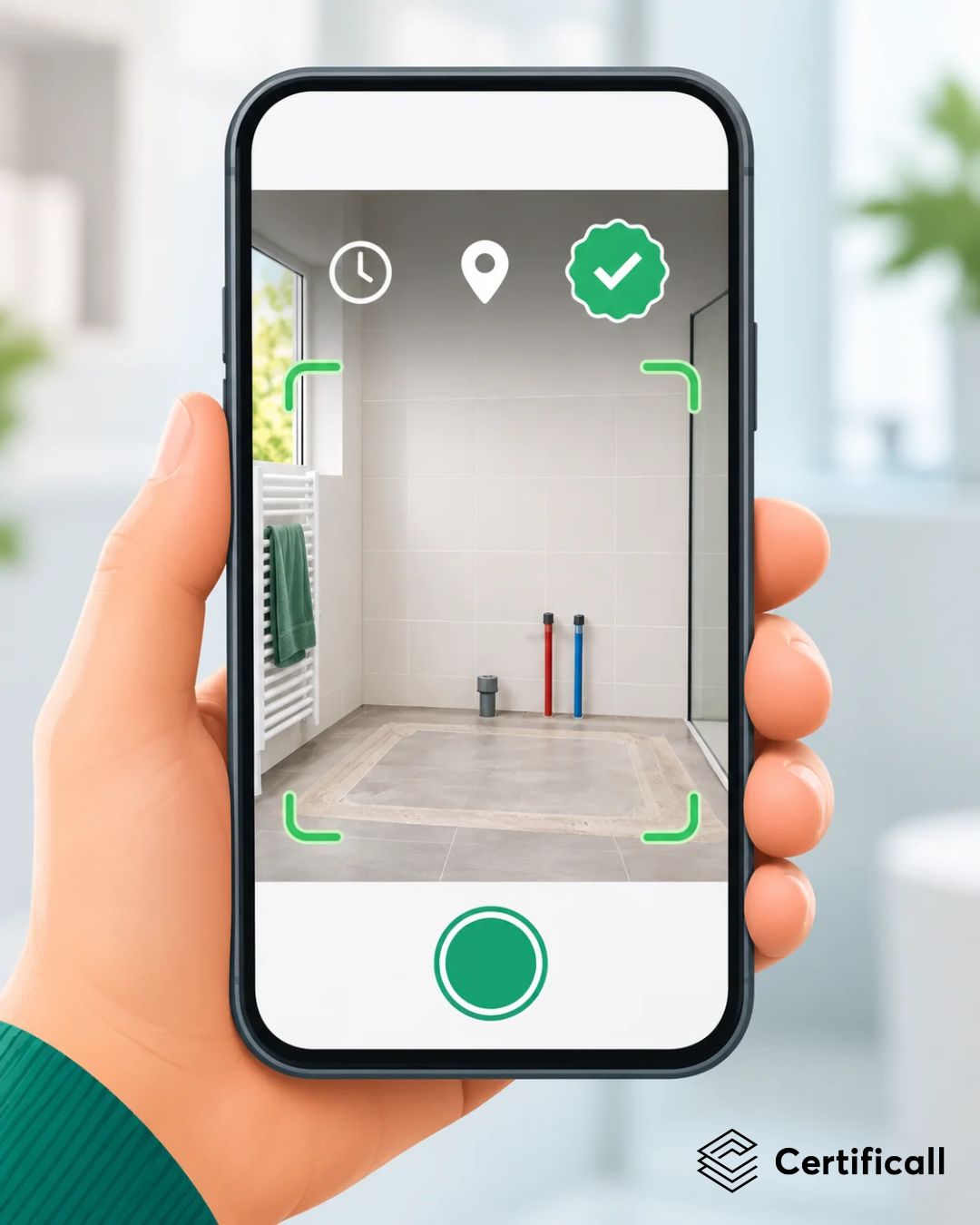
An ordinary bathroom photo does not show when it was taken, where, or whether it was edited. A capture certified by Certificall answers all three questions:
- The date: a qualified electronic time stamp under the eIDAS regulation.
- The location: the geolocation of the shot, linked to the property’s address.
- The integrity: a qualified electronic seal that makes any change detectable.
The ORKA.TAX method: simulate, analyse, claim
ORKA.TAX is a property tax analysis service designed by two Paris lawyers, Manon Bellin and Gary Cahn, co-founders of the law firm Neora Avocats. Its mission is to let every owner know exactly what they should pay.
The taxe foncière claim process has three steps, described on the ORKA.TAX How we work page (in French):
- Simulate, free of charge. The owner enters their municipality and a few features of the property. The simulator estimates the tax due and the possible gap in about sixty seconds.
- Analyse, for €78 per property. ORKA.TAX obtains the property’s 6675-M assessment form from the tax authorities. Each item is compared with the actual property, and the gaps are quantified, usually within 2 to 6 weeks.
- Claim, at no extra cost. ORKA.TAX prepares the arguments, the form annotated item by item, the supporting documents and the claim letter. The owner files the claim personally from their impots.gouv.fr account. The authorities reply within 2 to 4 months on average.
The owner stays in control: no power of attorney is required, and they decide whether or not to file. ORKA.TAX also points out that the simulation alone is not enough to support a claim: only the assessment form confirms a gap.
How can you prove your taxe foncière is too high?
A claim must state its grounds and include the documents that support it (article R*197-3 of the French Book of Tax Procedures, LPF). The burden of proof therefore lies with the owner.
The file prepared by ORKA.TAX brings together several types of evidence: photos, invoices for works, a certificate from the building manager for common areas, floor area measurements. Of these, photos are the easiest to produce and the easiest to question.
An ordinary photo may have been taken elsewhere, on another date, or edited. That is why an ordinary photo proves nothing until its date, location and integrity are guaranteed.
Ordinary photo
Date can be changed in the metadata. Location cannot be verified. Edits invisible to the eye. Value left to the judgement of the official reviewing the claim.
Certificall certified photo
Date fixed by a qualified time stamp. GPS position recorded when the shot is taken. Sealed file: any change is detectable. Verifiable certificate attached to the file.
What Certificall brings to the claim file
Certificall turns a photo of a bathroom, a cellar or a removed meter into evidence that is dated, geolocated and sealed, attached to the file prepared by ORKA.TAX.
Owners take their captures on site with their own smartphone. Each photo or video receives:
- a qualified electronic time stamp, issued by a qualified trust service provider;
- the geolocation of the shot, for a time-stamped and geotagged photo linked to the property;
- a qualified electronic seal under eIDAS, which seals the file;
- secure storage in France, in compliance with the GDPR.
These safeguards rely on the eIDAS regulation, the European framework for trust services. They give each capture strong evidential value: its date, location and integrity will be hard for the authorities to dispute.
The mechanisms are explained in detail on the page presenting our certification technology. The partnership integrates Certificall directly into the ORKA.TAX journey: detection and evidence are built in the same file.
Use cases: what certified evidence documents
The five cases below are published by ORKA.TAX, based on its clients’ tax relief notices. They predate the Certificall integration. The last column is our own analysis: it shows what a certified capture can document in each situation.
| Case | Error found | Published outcome | What a certified capture documents |
|---|---|---|---|
| Flat, cellar and parking space, Paris 19th | One rubbish chute too many, a “good” condition recorded for all three units | Condition revised to “fair”, rubbish chute removed: €404 refunded for 2025 and 2026 | The absence of the rubbish chute and the actual condition of each unit |
| Flat, garage and cellar, Saint-Raphaël | 90 m² recorded for 85 m² in reality, too many amenities, noise nuisance ignored | €318 refunded; 2026 tax reduced from €1,834 to €1,669 | Measurements taken on site, the actual amenities, the nearby stations on video |
| House with laundry room and garage, Avignon | Overstated areas (a 30 m² laundry room that measures 20 m²), extra rooms | €302 refunded; 2026 tax reduced from €2,870 to €2,717 | The number of rooms on each level and the measurements of each space |
| Flat and cellar, La Garenne-Colombes | Gas counted despite a removed meter, a sealed rubbish chute still on record | Both items removed thanks to proof of meter removal and a building manager’s statement: €140 refunded over 3 years | The spot where the meter was removed and the sealed chute hatch |
| Flat and cellar, Paris 12th | A “special location” status that increased the property’s value | Location reset to “ordinary”: €23 for 2025; a second request on the state of repair was refused | The immediate surroundings and the state of repair, the item that relies most on visual evidence |
Source: ORKA.TAX success stories page (in French). The cases are a selection, and their outcomes do not predict the result of any other claim.
The amounts remain modest for a single flat. Yet they recur every year until the property’s description is corrected.
Limits to know before filing a claim
A well-prepared claim does not guarantee a result. Four points are worth knowing before you start.
- Tax rates cannot be challenged. Only the base, in other words the rental value, can be corrected.
- The deadline is set by law. For local taxes, a claim must generally be filed by 31 December of the year following the year the tax was collected (article R*196-2 of the LPF).
- The authorities assess each item separately. They may accept one correction and refuse another, as the Paris 12th case shows.
- The evidence must match the error. A certified photo proves the condition of a place at a given moment. It does not replace an invoice for works, a building manager’s statement or, in the most contentious cases, a report by a commissaire de justice (court officer).
Co-ownerships, landlords, property managers: the same logic at scale
What applies to one flat applies to a whole building or portfolio. An amenity removed from every unit in a residence weighs on each of the property tax bills concerned.
Co-ownerships, private landlords and social housing providers often already hold photos of their buildings: surveys, inventory photos, claims follow-up. Switching to certified capture lets them build reusable evidence, as shown on our certified photo page for real estate.
We will publish dedicated articles for co-ownerships and social landlords. For an individual owner, the price of a certified photo is small compared with the average gap observed.
Before filing your claim, check five points
- The assessment form. You have your property’s 6675-M form: it is what confirms the gap.
- The items contested. Each gap is linked to a specific item and to the legal text behind it.
- The visual evidence. Each contested item is photographed or filmed on site with a certified capture.
- The supporting documents. Removal invoices, building manager’s statement and floor area measurements complete the images.
- The deadline. You file the claim by 31 December of the year following the year the tax was collected.
ORKA.TAX and Certificall: from detected error to certified evidence
ORKA.TAX identifies and quantifies the error using the official assessment form. Certificall provides evidence of the property’s actual condition. Together, the two services give owners a complete journey: from detecting the anomaly to a well-evidenced claim file.
To check whether your taxe foncière is overvalued, run the free simulation on orka.tax.
Landlords, co-ownership managers, property managers: add certified evidence to your files
Dated, geolocated and sealed captures, taken by your teams in the field.
The questions we really get asked about contesting the taxe foncière
- ❓ How do you contest your taxe foncière?
- First obtain the property’s assessment form, then compare each item with the actual property. The gaps are then set out in a reasoned claim, with supporting documents, filed from the owner’s impots.gouv.fr account.
- ❓ What supporting documents should a property tax claim include?
- The most common are photos of the property, invoices for works, a building manager’s statement for common areas and floor area measurements. Photos certified by Certificall guarantee the date, location and integrity of each image.
- ❓ What is the 6675-M assessment form?
- The 6675-M form is the tax authorities’ document describing a property for the calculation of its rental value: floor areas, amenities, category, state of repair and outbuildings. It is not sent to owners automatically. ORKA.TAX requests it on the owner’s behalf during the analysis.
- ❓ Can you get a refund for previous years?
- Yes, for the years still within the claim deadline. For local taxes, this deadline generally runs until 31 December of the year following the year the tax was collected. The correction then applies to the following years.
- ❓ Can the state-of-repair coefficient be lowered?
- Yes. Article 324 Q of annex III to the CGI sets a scale based on the building’s condition. On 22 December 2025, the Conseil d’État ruled that a house with defects due to age fell into the “fair” category. Certified photos of the actual condition support the request.
- ❓ Is a smartphone photo enough as evidence?
- An ordinary photo can be challenged, because its date, location and content can be altered. A photo certified by Certificall receives a qualified eIDAS time stamp, geolocation and a qualified electronic seal, which make these elements hard to dispute.
- ❓ How much does the ORKA.TAX analysis cost, and who files the claim?
- The simulation is free. The full analysis costs €78 per property, outbuildings included, and covers the preparation of the claim file. The owner files the claim personally, in their own name, without a power of attorney.