
Boris Eldagsen was right: AI now mass-produces fake photos
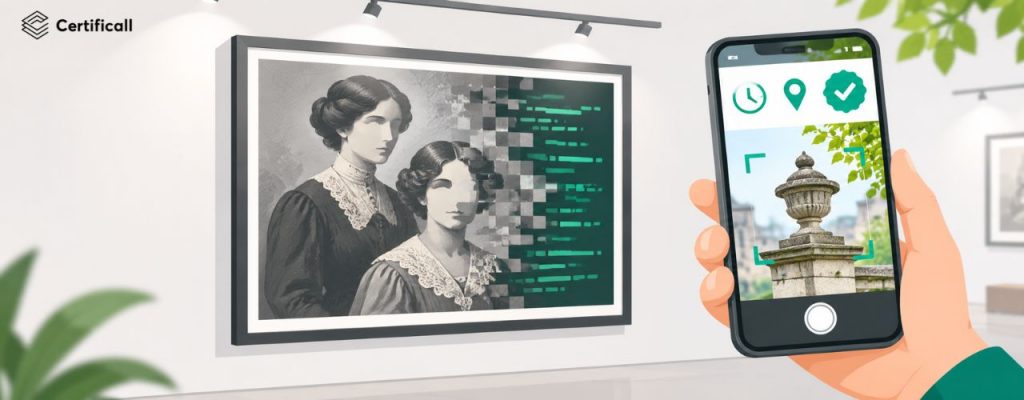
Who still remembers Boris Eldagsen? In April 2023, the German artist turned down the award he had just won at the Sony World Photography Awards with an image generated entirely by artificial intelligence. At the time, many saw it as an artist’s stunt. Three and a half years later, his gesture looks more like a warning nobody really wanted to hear.
Key points in 30 seconds
- In 2023, Boris Eldagsen won a major photography award with an image made with DALL-E 2, then refused the prize to warn about the confusion between photography and AI.
- His image took several days of work. In 2026, consumer generative AI produces a photorealistic image in seconds.
- According to a 2025 study by Microsoft’s AI for Good Lab, people tell a real photo from an AI image only 62% of the time.
- Certificall does not try to spot fakes after the fact: Certificall certifies the real photo at the moment of capture, with an eIDAS qualified electronic time stamp and a qualified electronic seal.
Boris Eldagsen and “Pseudomnesia”: what happened in 2023
In March 2023, Boris Eldagsen was named winner of the Creative Open category at the Sony World Photography Awards. His work, Pseudomnesia: The Electrician, shows two women of different generations, in a black-and-white style reminiscent of 1940s family photographs.
Pseudomnesia is a series of images by Boris Eldagsen whose title means “fake memory”: portraits that look like archive photographs but were never taken with a camera.
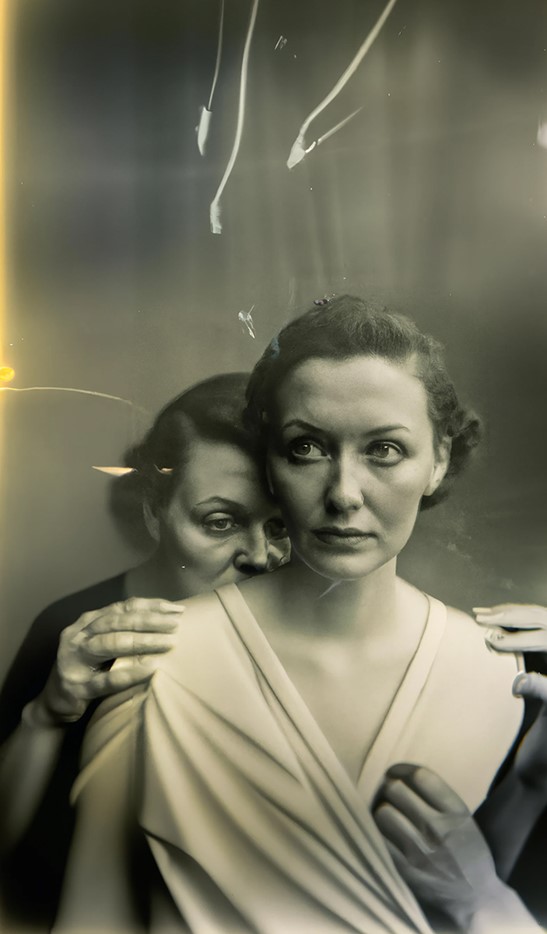
The image was produced with the DALL-E 2 generator. Eldagsen worked with prompts, then reworked details through inpainting and extended the frame through outpainting. He explains that the process took days, with many attempts discarded along the way. He had entered the image in three competitions, with nothing but its title. It was shortlisted every time.
On 14 April 2023, at the ceremony in London, he refused the prize and revealed where the image came from. His words travelled around the world: “AI is not photography.” He said he had entered as a “cheeky monkey”, to find out whether competitions were prepared for AI images. His conclusion: they were not.
What the organisers say
The artist had not made the extent of his use of AI clear. The Creative category welcomed experimental practices. After his refusal, the work was removed from the competition and the exhibition.
What Boris Eldagsen says
He spoke of “co-creation” with AI as soon as his win was announced and called for a public debate. His goal was not to keep a prize, but to force the photography world to draw a line.
A warning, not just a trick
Much of the debate focused on whether he had cheated. The real issue lay elsewhere. If a jury of image experts cannot spot an AI image, who will? A claims handler? A site manager? A judge?
In hindsight, Pseudomnesia looks almost like a work of public interest. Eldagsen did more than fool a jury. He also called for images to be clearly labelled as authentic, edited or generated. That is exactly the question insurers, loss adjusters and companies receiving photos as evidence are asking today.
In Greek mythology, Cassandra could see the future, but nobody believed her. In 2023, the affair was treated as a quarrel among artists. Yet it foreshadowed a societal problem: the production of fakes at scale.
From one artwork to mass-produced fakes: three years of generative AI
In 2023, producing a convincing AI image took technical skill, several days of work and an artist’s eye. Not anymore. Generative AI is now built into assistants that hundreds of millions of people use every day, often for free.
700M
Images in one week
Generated by more than 130 million ChatGPT users after its new image generator launched in late March 2025 (OpenAI).
5bn
Images in under two months
Created with the image model of the Gemini app launched in late August 2025 (Google).
62%
Correct answers
When telling real photos from AI images, across around 287,000 evaluations (Microsoft AI for Good Lab, 2025).
The authors of the Microsoft study acknowledge it themselves: generators are improving so fast that their results probably overestimate how well people can spot fakes today. Fakes are no longer a feat. They are an everyday service.
The consequences reach far beyond photo competitions. An AI-generated photo is now enough to pull off a €1,440 scam on a private homeowner. AI-generated images have even reached satellite views, long considered neutral. And an ordinary photo proves nothing on its own when its origin is in doubt.
Label the fake or certify the real?
Regulators have responded. Article 50 of the EU Artificial Intelligence Act (AI Act) has applied since 2 August 2026. It requires providers to mark AI-generated content in a machine-readable format. A grace period until 2 December 2026 was granted for this marking obligation. On the industry side, AI watermarking and the C2PA standard document the origin of content.
These tools are useful and complementary. They show that an image comes from an AI when the mark is present. But the ecosystem is still being rolled out: the absence of a mark is not, on its own, proof that a photo is authentic. That is why the problem must also be tackled from the other end: certify the real rather than chase the fake.
Capture-time certification means sealing a photo at the very moment it is taken, to prove its date, location and integrity before any manipulation is possible.
What Certificall takes from Boris Eldagsen’s lesson
At Certificall, we share Boris Eldagsen’s conclusion: an image no longer proves anything by itself. With Certificall’s certified photo app, the photo is taken with the app’s own camera. It immediately receives a qualified electronic time stamp under the eIDAS Regulation, issued by a qualified trust service provider. It is geolocated, sealed with a qualified electronic seal, then archived in France.
Any later change to the certificate becomes detectable, because the file’s digital fingerprint changes. Doubt no longer rests on the image, but on a verifiable fact: was this photo certified, yes or no? The photo-of-a-photo case is handled by Certificall’s in-house AI. To find out more, explore our certification technology.
Contact us to integrate Certificall into your business processes
Photos time-stamped, geolocated and sealed from the moment of capture.
The questions we really get asked about Boris Eldagsen and AI images
- ❓ Who is Boris Eldagsen?
- Boris Eldagsen is a German artist with a background in photography who specialises in the relationship between AI and images. He is known for winning the Creative Open category of the 2023 Sony World Photography Awards with an AI-generated image, then turning the prize down.
- ❓ Why did Boris Eldagsen refuse his award?
- Boris Eldagsen refused the award to start a public debate. He believes AI is not photography and that AI images should compete in separate categories. He wanted to show that photo competitions were not ready to tell the difference.
- ❓ Can people still tell a real photo from an AI-generated image?
- Less and less. A study by Microsoft’s AI for Good Lab published in 2025 found a success rate of 62% across around 287,000 image evaluations. The authors believe this figure already overestimates people’s ability against the latest generators.
- ❓ Which platforms offer content verification options to limit the risks of deepfakes?
- Two approaches work together. Image generators and the C2PA standard can label and verify where content comes from. Capture-time certification platforms such as Certificall prove that a real photo was taken at a given date and place, unaltered since.
- ❓ Can a photo certified by Certificall be an AI-generated image?
- The photo is taken with the Certificall app’s own camera, then time-stamped, geolocated and sealed at the moment of capture. Photographing a screen is a challenge shared by every photo collection tool: Certificall addresses it with its own analysis AI, developed in-house.